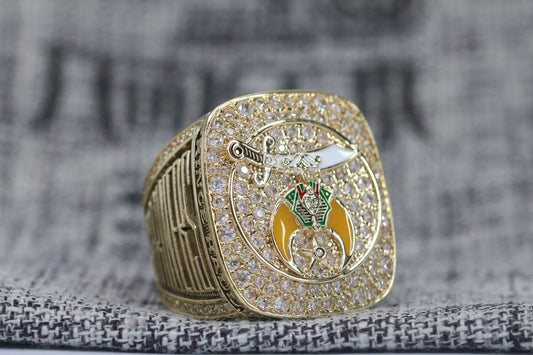

Shriners are known for bold symbols: the red fez, the crescent and scimitar, the sphinx, the star, and a long tradition of personalized fraternal regalia. But some Shriners rings also feature a black stone, which raises a fair question:
Does the black stone have a real connection to Shriners, or is it simply a jewelry design choice?
The honest answer is: there is historical connection, but it should be described carefully. A black stone is not listed by Shriners International as one of the main public symbols of the fraternity, but black stone references do appear in historical Shrine material and in historical descriptions connected to early Shrine ceremonial settings.
The Public Symbols of Shriners International
Shriners International officially highlights the red fez as one of the fraternity's most distinctive symbols. The fez was chosen to complement the fraternity's original Arabian-inspired theme, ceremonies, and events. Each fez is personalized with information such as the member's chapter, positions, clubs, or units.
The official emblem on the fez is the crescent and scimitar. According to Shriners International, the scimitar represents the members, the two claws represent the fraternity and its philanthropy, the sphinx represents the governing body, and the five-pointed star represents the children helped by the philanthropy each year.
That matters because it tells us what we can say with certainty: the fez, crescent, scimitar, sphinx, and star are official, public-facing Shrine symbols. A black stone is not presented in that same way on Shriners International's public history page.
Where the Black Stone Connection Comes From
The Shrine fraternity was founded with an Arabian-inspired theme. Shriners International states that in 1870, a group of Masons in New York discussed forming a new fraternity based on Freemasonry, with added fun and fellowship. Actor Billy Florence had attended an Arabian-themed party while touring Europe, and that theme helped inspire the new fraternity's style, ritual, costumes, salutation, and red fez.
Within that historical context, some early Shrine-related publications mention a black stone. One historical book available through the Internet Archive describes a memorial decree from 1883 that refers to a sacred black stone in a ceremonial setting.
The same historical source also records that, in 1886, a Noble announced he had obtained a specimen of Black Stone from the precincts of Mecca, and that in 1887 this Black Stone was presented to Mecca Temple with letters and a description. The source says it then adorned the altar.
So the verified claim is this: black stone references do exist in historical Shrine-related material. But that is different from saying the black stone is an official modern Shriner symbol. That stronger statement is not supported by the official public sources available.
The Broader Black Stone Reference
The Shrine's early theme borrowed from an imagined Arabian and Middle Eastern aesthetic common in 19th-century fraternal culture. The phrase Black Stone naturally points to the famous Black Stone associated with the Kaaba in Mecca. The Black Stone, also called Hajar al-Aswad, is a revered Islamic relic set into the eastern corner of the Kaaba, and pilgrims may touch or kiss it during the tawaf ritual.
This does not mean Shriners are an Islamic organization. Shriners International describes the fraternity as rooted in Freemasonry, fun, fellowship, and philanthropy, and its official history explains that the Arabian theme influenced the organization's style and pageantry.
So, historically, the black stone connection is best understood as part of the Shrine's Arabian-inspired ceremonial imagery, not as a religious claim.
What a Black Stone Means on a Shriners Ring
On a modern Shriners ring, a black stone can be described safely and truthfully as a classic design element with historical resonance.
Black stones are common in men's jewelry because they create strong contrast against gold, silver, and enamel. On a Shriners ring, that contrast can make the design look more formal, distinguished, and ceremonial. The black stone works well because it gives the piece a bold focal point while keeping the overall look refined. It also pairs naturally with gold-tone metal and Shrine-style decorative details.
What We Can Say Honestly
You can say: Featuring a bold black stone, this Shriners ring draws on a classic fraternal jewelry look while nodding to historical black-stone references found in early Shrine-related material.
You can also say: The black stone adds contrast, depth, and a distinguished ceremonial feel to the design.
And: Black stone references appear in historical Shrine material, though the black stone is not presented by Shriners International as one of the fraternity's main official public symbols.
What We Should Avoid Saying
To stay accurate, avoid claims like these:
- The black stone is an official Shriners symbol.
- Every Shriner ring must have a black stone.
- The black stone has one single required meaning in Shrine jewelry.
- Shriners use black stones because of one confirmed official modern rule.
Those claims are too strong based on the available public evidence.
Final Takeaway
There is a real historical basis for connecting Shriners and black-stone imagery. Early Shrine-related material includes references to a sacred black stone and even a Black Stone associated with Mecca Temple in the 1880s. However, modern official Shriners International materials emphasize the fez, crescent, scimitar, sphinx, star, and philanthropy as the main public symbols.
The most accurate way to present a Shriners ring with a black stone is this: the black stone is a powerful and elegant design choice with historical resonance — not a symbol that should be overstated as an official requirement.